

Taekwondo — Taekwondo:
The Art of Foot & Fist
One of the world’s most practised martial arts — an Olympic sport, a self-defence system, and a lifelong path to physical and mental excellence. Train under Master K. Gopi Naidu, Guinness World Record Holder & 5th Dan Black Belt, at Temple of Taekwondo Academy, Tirupati.
The Way of the Foot & Fist
Taekwondo (Taekwondo) is a Korean martial art characterised by its emphasis on head-height kicks, jumping and spinning kicks, and fast kicking techniques. Developed in the 1940s–1950s and standardised in 1955, it has grown into one of the world’s most popular martial arts — practised by over 200 million people in 210+ countries.
The name itself tells the story: Tae (TAE) means “foot” or “to kick/strike with the foot”, Kwon (KWON) means “fist” or “to strike with the hand”, and Do (DO) means “the way” or “path”. Together: the way of foot and fist.
It became an Olympic demonstration sport in 1988 (Seoul) and a full Olympic sport in 2000 (Sydney) — and today it is one of only two Asian martial arts (along with Judo) featured at the Olympic Games.
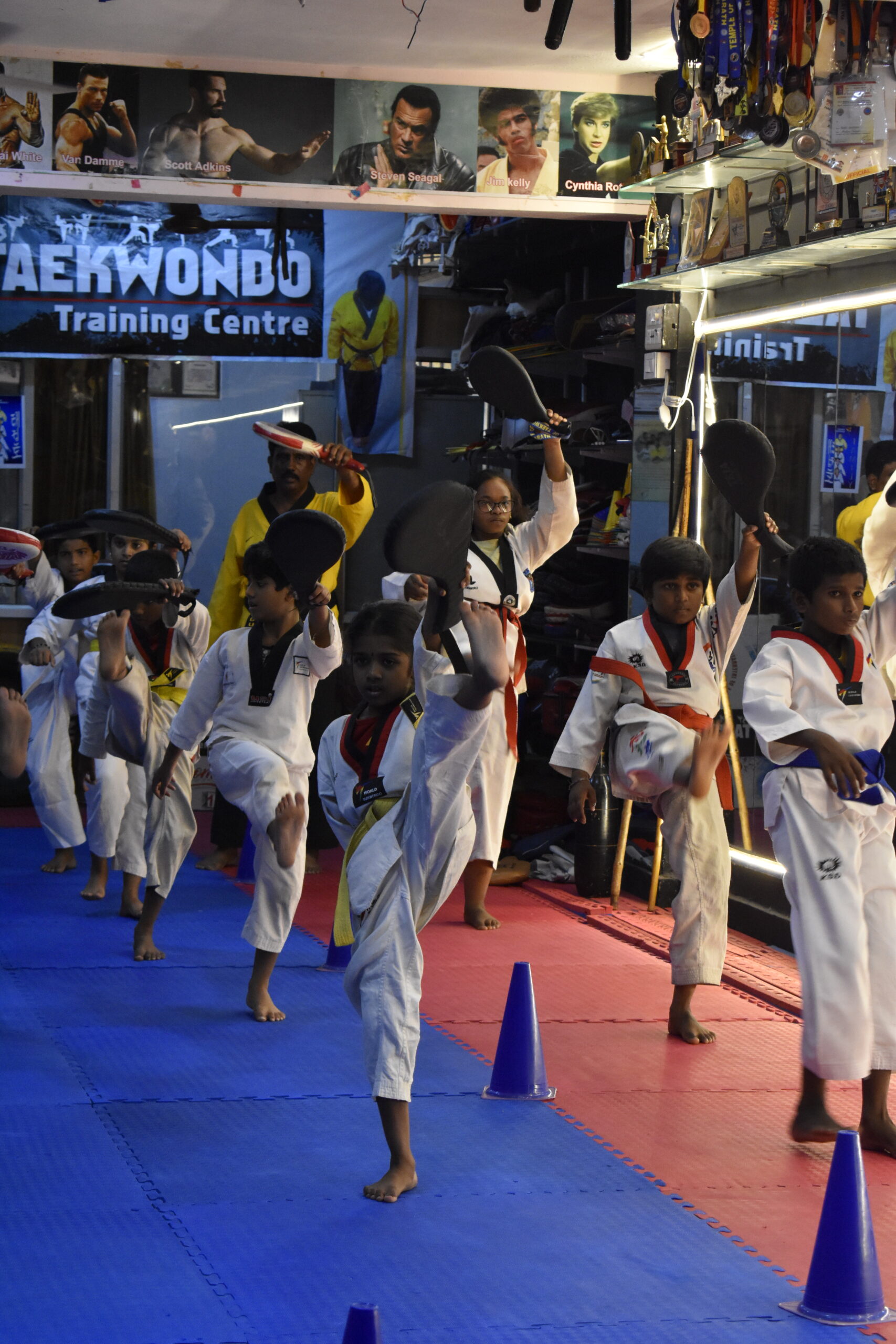
World-Class
Coaching
6 Types of Taekwondo
Taekwondo has evolved into several distinct styles and disciplines — each with its own focus, governing body, and training approach. Here’s what you need to know.
Olympic / WT Taekwondo
The most widely practised style globally, governed by World Taekwondo (WT) and sanctioned by the International Olympic Committee. Focuses on fast, high kicks in sparring (Kyorugi) and formal patterns (Poomsae).
- Olympic Games since Sydney 2000
- Kukkiwon belt certification
- Kyorugi (sparring) & Poomsae (forms)
- Electronic scoring system
ITF Taekwondo
Founded by General Choi Hong Hi in 1966. Known for its emphasis on patterns called Tuls (24 patterns representing 24 hours of a day), sine wave motion, and a different sparring ruleset with hand techniques.
- 24 Tul (pattern) system
- Sine wave body movement
- More hand techniques allowed
- Semi-contact sparring rules
Poomsae (Forms)
A sequence of defence and attack movements performed against imaginary opponents. Poomsae (WT) and Tul (ITF) are the form disciplines — combining power, balance, accuracy, and rhythm into a flowing art.
- Individual & pair categories
- Judged on accuracy & power
- 8 Taegeuk + Black Belt forms
- Now a competitive Olympic event
Kyorugi (Sparring)
The full-contact sparring competition format and the Olympic event. Points are scored by kicking the opponent’s torso or head. Requires speed, agility, timing, and tactical intelligence under intense pressure.
- The Olympic event format
- Weight-category divisions
- Electronic hogu scoring
- 3 rounds × 2 minutes
Kyokpa (Breaking)
Board and brick breaking demonstrates the real-world application of Taekwondo power and technique. Requires perfect form, focus, and commitment — a single poorly-executed technique results in failure or injury.
- Tests power & accuracy
- Aerial & spinning techniques
- Speed breaks & power breaks
- Competition & demonstration events
Hosinsul (Self-Defence)
The self-defence application of Taekwondo techniques adapted for real-world situations. Includes wrist grabs, chokes, weapon defences, and ground scenarios — especially important for women’s safety training.
- Real-world scenario training
- Women’s safety focus
- Joint locks & throws
- Weapon defence basics
Core Techniques
From beginner stances to advanced aerial kicks — here are the fundamental techniques taught at Temple of Taekwondo Academy.
What Taekwondo Does to Your Body
Decades of scientific research confirms what practitioners have known for centuries: Taekwondo delivers comprehensive physical, mental, and social health benefits at every age.
“Taekwondo training develops the mind and body simultaneously. Practitioners experience not only improvements in physical fitness, but also psychological benefits including reduced anxiety and depression, improved self-esteem, and greater emotional regulation.”
Four Pillars of Health
Every training session works your entire system — not just your muscles, but your mind, your social skills, and your future.
- Cardio fitness & lung capacity
- Muscle strength & tone
- Flexibility & joint health
- Weight management
- Balance & coordination
- Bone density improvement
- Stress & anxiety reduction
- Improved focus & attention
- Better academic performance
- Reduced screen addiction
- Emotional self-regulation
- Confidence & self-esteem
- Teamwork & camaraderie
- Respect for others
- Leadership development
- Anti-bullying behaviour
- Cultural awareness
- Community belonging
- Govt. college reservation quota
- Employment advantages
- Discipline transfers to work
- Goal-setting habits
- Perseverance & resilience
- Sports career pathway
Regular Taekwondo training significantly improves heart health. High-intensity sparring and kicking drills elevate the heart rate comparably to running, improving VO2 max, lowering blood pressure, and reducing the risk of heart disease.
The kicking-centric nature of Taekwondo develops extraordinary lower-body power. Practitioners develop quad, hamstring, glute, and calf strength far exceeding most gym-based leg programmes — through functional, athletic movements.
Head-high kicks demand and develop exceptional hip and hamstring flexibility. Students typically achieve full splits within 6–12 months. This flexibility reduces injury risk in all physical activities and maintains joint health well into old age.
A one-hour Taekwondo session burns 400–700 calories, making it highly effective for weight loss. More importantly, the muscle gained increases resting metabolic rate — so you burn more even when inactive.
Physical exercise combined with the meditative aspects of Poomsae practice significantly lowers cortisol levels. Students consistently report better sleep, reduced anxiety, and a calmer response to daily pressures within weeks of starting.
Memorising patterns, executing techniques with precision, and reading opponents in sparring all strengthen the neural pathways for attention and concentration. Children with ADHD show measurable improvement through martial arts training.
Impact training strengthens bones through the same mechanism as weight-bearing exercise. Taekwondo stances correct habitual slouching, developing a strong upright posture that prevents back pain and projects confidence.
Sparring requires lightning-fast reactions to read, evade, and counter attacks in fractions of a second. This neural training improves reflexes that transfer to driving, sports, and everyday physical safety.
The progressive belt system gives students constant measurable goals. Each achievement builds genuine confidence — not just the belief that you can defend yourself, but the calm, quiet assurance that changes how you carry yourself every day.
Taekwondo as Self-Defence
Taekwondo is one of the world’s most effective self-defence systems — practical, powerful, and adaptable to real-world situations. Here’s what makes it truly defensive.
Longest Natural Weapon — The Leg
Your legs are 4x stronger than your arms and give you a 1–1.5m reach advantage over a hand-striking opponent. Taekwondo’s kick-first approach maximises this biomechanical advantage to keep threats at a safe distance.
Speed Over Power — Instant Response
Taekwondo techniques emphasise explosive speed — a front kick or palm strike can be deployed within 0.3 seconds of perceiving a threat. Speed neutralises size and strength advantages of a larger attacker.
Women’s Safety Training
Taekwondo’s hosinsul techniques are particularly effective for women — targeting vulnerable points (knees, groin, nose, instep) where physical size is irrelevant. Our dedicated women’s batches provide a safe learning environment.
Stranger Danger — Child Safety
We teach children situational awareness, when to run, when to shout, and how to break a wrist grab or pull away from a restraint. Equally important: the confidence that prevents children from appearing as easy targets.
Target Points — Anatomical Precision
Taekwondo practitioners learn human anatomy targets — the solar plexus, floating rib, knee, nose, and temple. A single well-placed technique to these points ends a confrontation regardless of the attacker’s size or strength.
Situational Awareness & De-escalation
True martial arts wisdom begins before physical contact. Our training emphasises reading situations, maintaining distance, de-escalation, and choosing engagement as a last resort — the philosophy of protecting life, not proving dominance.
The Belt Ranking System
The coloured belt system provides a clear, measurable pathway of progression — giving students constant goals and visible recognition of their growing mastery.
The beginning — symbolising innocence and a fresh start. Basics of stances, front kick, and low block. Building the foundation of a lifetime practice.
White Belt — Huin TiRepresents the earth from which a plant sprouts — the first signs of a growing foundation. Introduction to Taegeuk Il Jang (first form) and roundhouse kick.
Yellow Belt — Noran TiSymbolises growth — the plant is growing upward. Side kicks, back kicks, and more complex patterns introduced. Sparring begins in earnest at this stage.
Green Belt — Chorong TiSky blue represents heaven — the plant is reaching upward toward the sky. Advanced kicks, axe kick, spinning techniques, and tactical sparring development.
Blue Belt — Paran TiDanger — the practitioner is dangerous and must exercise control. Advanced spinning kicks, competition sparring strategy, and preparation for the Black Belt test.
Red Belt — Ppalgan TiMastery of the basics — the opposite of white, absorbing all colours. Not the end but the beginning of true learning. Master Gopi Naidu holds the prestigious 5th Dan from Kukkiwon.
Black Belt — Geomeun TiFor practitioners under 15 who pass the Black Belt exam — red and black stripes. Automatically upgrades to Dan upon turning 15. Our youngest competition achievers hold this rank.
Junior Black — PoomInternationally recognised master instructors. 4th–6th Dan are Masters; 7th–9th are Grand Masters. Certification is issued by Kukkiwon — the World Taekwondo Headquarters in Seoul.
Master / Grand MasterThe Five Tenets
Every Taekwondo student recites these five principles before each session. They are not just training rules — they are a code for living well.
Courtesy
Showing respect to instructors, fellow students, and all people. Bowing, listening, and treating everyone with dignity — inside and outside the dojang.
Integrity
Knowing right from wrong and having the conscience to feel shame for wrongdoing. Honesty in training, competition, and daily life.
Perseverance
The will to push through difficulty and not give up. Every black belt is the result of a white belt who never quit. Perseverance separates the good from the great.
Self-Control
Control of actions, emotions, and reactions — both physically and mentally. The most powerful person is the one who masters themselves, not others.
Indomitable Spirit
An unconquerable spirit that persists against injustice and adversity. The courage to stand for what is right regardless of the odds or opposition faced.
From Beginner to Champion
Here’s what your training journey looks like at Temple of Taekwondo Academy — a clear roadmap from your very first day to international competition.
Foundation (White – Yellow Belt)
Learn your first stances, basic blocks, front kick, and roundhouse kick. Begin Taegeuk Il Jang (first form). Build flexibility through daily stretching routines. Form habits of discipline, punctuality, and respect in the dojang.
Development (Green – Blue Belt)
Introduce side kicks, back kicks, and axe kick. Begin controlled sparring to apply techniques under pressure. Learn Poomsae forms 2–4. First district competition opportunity. Noticeable improvement in flexibility, fitness, and confidence.
Refinement (Red Belt)
Advanced spinning and jumping kicks. Tactical sparring with developed strategy. Poomsae forms 5–8. State-level competition preparation. Self-defence applications (Hosinsul). Preparation begins for the Black Belt examination.
Mastery (1st Dan Black Belt)
The Black Belt test — a comprehensive examination of all techniques, forms, breaking, sparring, and theoretical knowledge. Kukkiwon certification issued from the World Taekwondo Headquarters, Seoul. National competition eligibility unlocked.
Champion (Competition Path)
With Master Gopi Naidu’s guidance, our top students compete at state championships, national open tournaments, and international invitational events. Several have represented Andhra Pradesh at national level and won medals at open internationals.
Taekwondo Opens Official Doors
Unlike most extracurricular activities, Taekwondo is officially recognised by the Government of Andhra Pradesh as a competitive sport — which means your training directly benefits your education and career through formal reservation provisions.
College Admission Quota
State and central government colleges reserve seats for Taekwondo players — giving trained athletes a significant advantage in securing admissions to prestigious institutions.
Government Employment Reservation
State and central government employment programmes include sports quota positions specifically for recognised martial arts including Taekwondo.
Official Kukkiwon Certification
Belt certificates issued by Kukkiwon — the World Taekwondo Headquarters — are internationally recognised credentials accepted by sports bodies and institutions worldwide.
Real Training · Real Results —
Explore Our Gallery
Photos and videos from training sessions, competitions, award ceremonies, and camps across India and the world.
View Full Gallery →