
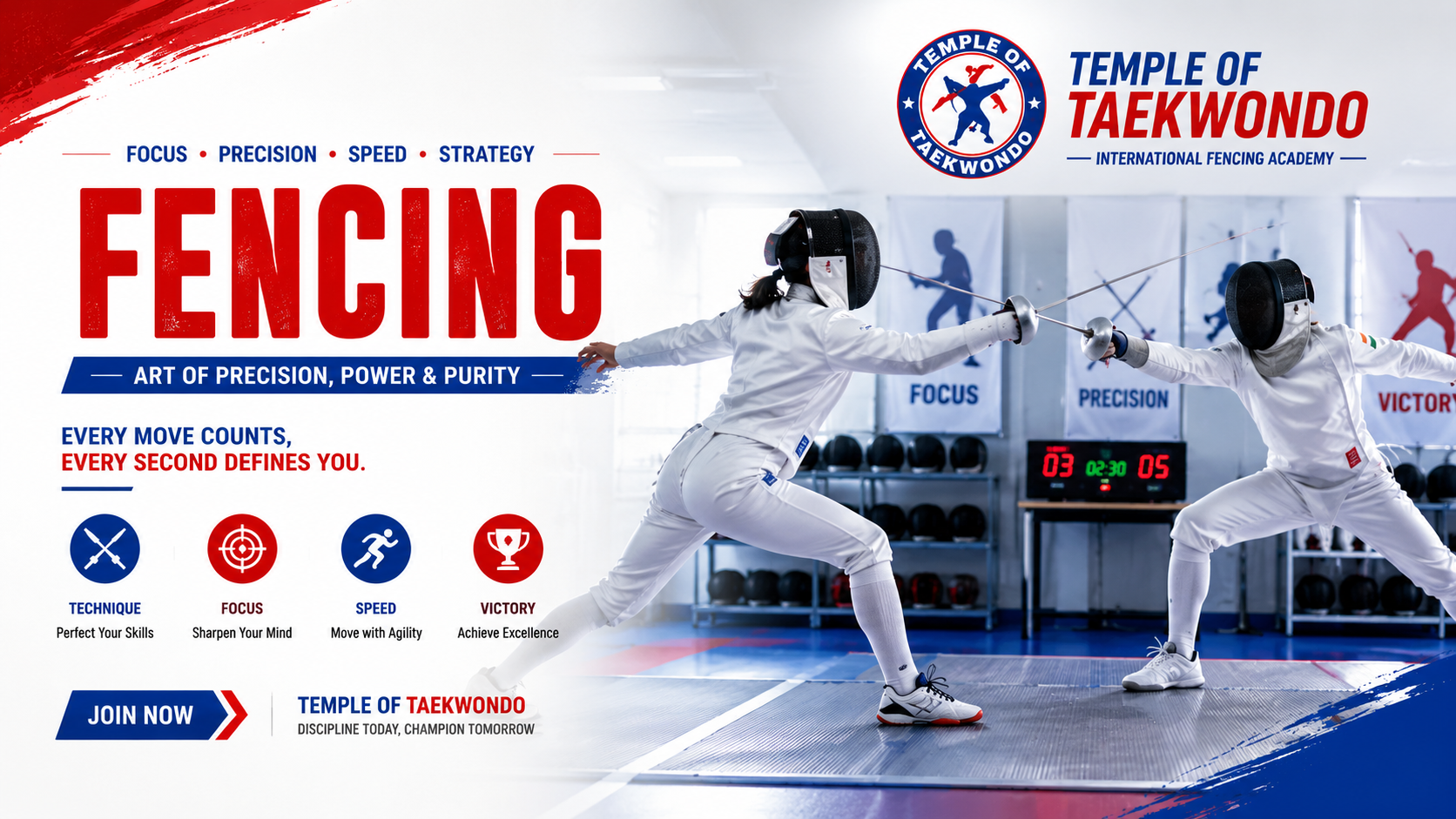
FENCING — The Sport of
Kings & Champions
The world’s most intellectually demanding Olympic combat sport — where lightning reflexes, razor-sharp strategy, and unbreakable focus collide on a 14-metre strip. Train under Master K. Gopi Naidu, Guinness World Record Holder, at Temple of Taekwondo Academy, Tirupati.
The Art of the Blade
Fencing is one of only five sports to have appeared at every single Modern Olympic Games since Athens 1896. Often called “physical chess”, it is the rare sport that demands equal measures of explosive athleticism and deep tactical intelligence — a full-body, full-mind combat discipline unlike anything else.
Two opponents face each other on a 14-metre strip called the piste, armed with one of three weapons — the Foil, the Epee, or the Sabre. The objective: score touches on your opponent’s valid target area before they score on you. Bouts are explosive, decisive, and intensely strategic.
With roots in ancient Egyptian, Greek, and Roman sword training, fencing was codified into its modern form in the 18th century in Europe and has been a pillar of Olympic sport ever since. Today it is practised by millions worldwide — from children developing focus, to elite athletes competing for Olympic gold.
Selected for
Nationals
6 Types of Fencing Competition
Fencing competitions take many forms across three weapons, individual and team events, and different age categories. Here is a complete guide to the world of competitive fencing.
Individual Foil
The classic entry-level discipline. Clean, precise thrusting technique to the torso. Right of way rules teach fencers to attack with intention and defend with timing — the cornerstone of all fencing education.
- Torso target only — 4 panels
- Right of way (priority) system
- Electronic scoring with lame jacket
- Best starting weapon for beginners
Individual Epee
The purist’s weapon — the entire body is target, no right of way, and simultaneous hits score double. Rewards patience, timing, and tactical deception. The closest modern equivalent to classical sword duelling.
- Entire body is valid target
- No priority rules — pure timing
- Simultaneous double-hits allowed
- Heaviest weapon — 770g max
Individual Sabre
Lightning-fast exchanges where bouts are won and lost in fractions of a second. Cuts and thrusts both score on the upper body. The most visually spectacular and explosively athletic of the three weapons.
- Upper body target — waist up
- Both cuts and thrusts score
- Right of way (priority) applies
- Fastest footwork in all fencing
Team Fencing
Three fencers per team compete in a relay format — 9 bouts of 3 minutes each, with running scores. Requires teamwork, communication, tactical substitutions, and the ability to fence under collective pressure.
- 3 fencers per team
- 9 bouts — first to 45 touches
- Olympic team event since 1904
- Develops leadership & teamwork
Modern Pentathlon Fencing
Fencing is one of five disciplines in the Modern Pentathlon alongside swimming, horse riding, running, and shooting. The Epee is used in a special round-robin format where every fencer faces every other fencer once.
- Epee weapon — one-touch bouts
- Round robin — all vs all
- Part of Olympic Modern Pentathlon
- Scores contribute to overall rank
Para & Wheelchair Fencing
Fencing for athletes with physical disabilities, contested in wheelchairs fixed to the piste. Adapted rules maintain the full tactical complexity and excitement of the sport. A full Paralympic discipline at every Games since 1960.
- Paralympic sport since Rome 1960
- Wheelchair fixed to frame on piste
- Foil, Epee & Sabre events
- Open to all physical disability classes
Core Fencing Techniques
From the basic on-guard stance to advanced compound attacks — here are the fundamental techniques taught at Temple of Taekwondo Academy.
What Fencing Does to Your Body & Mind
Fencing delivers a rare combination — a full-body aerobic and anaerobic workout combined with intense cognitive demand. Every bout trains your brain as hard as your body.
“Fencing produces one of the highest cognitive loads of any sport. Fencers must process spatial information, anticipate opponent behaviour, recall tactical patterns, and execute complex motor skills — all simultaneously, in real time, at extreme speed.”
Total Development — Body & Brain
Fencing is one of the few sports that develops physical fitness, mental sharpness, emotional intelligence, and social skills all in the same session.
- Full-body cardiovascular workout
- Explosive leg & core strength
- Upper body precision & control
- Coordination & balance
- Reaction time improvement
- Calorie burn — 400–600 per hour
- Strategic thinking under pressure
- Pattern recognition & memory
- Improved academic focus
- Reduced anxiety & stress
- Decision-making speed
- Emotional self-regulation
- Sportsmanship & honour code
- Respectful competition
- Teamwork in group training
- Building lasting friendships
- Cultural sophistication
- Club & team identity
- AP Govt. college quota advantage
- State employment sports quota
- National competition pathway
- Problem-solving skills
- Resilience & adaptability
- Discipline across all domains
Neuroscience research shows fencing activates more areas of the brain simultaneously than almost any other sport. Fencers develop exceptional working memory, spatial reasoning, and pattern recognition — skills that transfer directly to academic and professional excellence.
Elite fencing actions occur in 2–4 milliseconds — faster than the conscious brain can process. Training develops unconscious, automated responses to visual and tactile stimuli. Fencers’ reaction times are among the fastest measured in any sport.
The fencing lunge demands and develops extraordinary quadricep and glute explosive power. Repeated lunges, advances, and retreats build lower-body conditioning comparable to elite sprint training — all in the context of a tactical sport.
Fencing demands that both sides of the body work in perfect — yet independent — coordination. The weapon arm performs precise blade actions while the legs drive dynamic footwork patterns. This cross-body neural demand builds exceptional general coordination.
The on-guard stance and all fencing actions require a strong, stable core and an upright, controlled posture. Fencers develop natural, correct posture that eliminates back pain, improves appearance, and signals confident body language in daily life.
Studies consistently show fencing students outperform non-fencing peers academically. The strategic thinking, memorisation of tactical patterns, and focused concentration trained in the salle carry directly into the classroom — making fencers exceptional students.
Bouts combine short explosive bursts with sustained aerobic effort — an interval training structure that science confirms is the most efficient method for building heart health. Fencing improves VO2 max, lowers resting heart rate, and builds lasting cardiovascular endurance.
Every bout won, every parry landed, every competition medal earned builds deep, genuine confidence. Fencing teaches students that skill, preparation, and strategy — not size or strength — determine outcomes. This lesson reshapes how students see themselves in every area of life.
Fencing demands total present-moment focus — there is no room for distraction when an opponent’s blade is moving toward you at speed. This enforced mindfulness clears mental noise, reduces cortisol, and produces a state of flow that leaves students calm, refreshed, and mentally clear.
Scoring & Rules of Fencing
Understanding fencing rules makes every bout more exciting to watch and to compete in. Here is everything you need to know about how modern competitive fencing works.
Bouts are fought on a strip called the piste — 14 metres long and 1.5–2 metres wide. Each fencer has a retreat zone behind them. Stepping off the side earns the opponent a warning; being forced off the back end concedes a touch.
All touches are registered electronically. Fencers are connected via a retractable cable (or wireless system) to the scoring box. When a valid touch lands on the correct target area, a buzzer sounds and a light activates — removing any doubt about scoring.
Individual bouts are 3 periods of 3 minutes each, first to 15 touches (direct elimination) or points accumulated over 3 periods (pools). In pool rounds, bouts are first to 5 touches in 3 minutes. Team bouts are 9 periods of 3 minutes, first to 45 touches.
In Foil and Sabre, simultaneous hits are decided by right of way — the fencer who initiated the attacking action scores the point. The attacking fencer has right of way; to take priority back, the defender must parry first. In Epee, simultaneous touches within 40ms both score.
Every bout begins and ends with a formal salute — fencer to fencer, and fencer to referee. This tradition reflects fencing’s roots in duelling culture and represents mutual respect between competitors. It is one of the most distinctive and meaningful rituals in Olympic sport.
Fencing equipment is rigorously safety-tested. The mask withstands 350 Newtons of force; the jacket and breeches are made of cut-resistant material rated to 800 Newtons. Modern fencing equipment makes this centuries-old sword sport one of the safest Olympic disciplines.
Bouts are overseen by a referee who tracks right of way in Foil and Sabre, ensures fair play, issues cards for rule violations, and resolves disputes. Video replay is available at senior international competitions for disputed actions.
Competitions begin with pool rounds where every fencer faces others in a group, generating a ranking. Top fencers advance to direct elimination rounds — a single-elimination bracket where a loss ends the competition. Rankings determine seedings in the elimination draw.
6 Reasons Fencing Stands Apart
There is no other sport quite like fencing. These are the qualities that make it one of the most transformative disciplines a person of any age can pursue.
Physical Chess — Sport & Strategy Combined
Fencing is called physical chess because every action requires both athletic execution and tactical thinking. You must simultaneously analyse your opponent’s patterns, set traps, execute feints, and react to their responses — all while managing your energy over a 9-minute bout.
No Size or Strength Advantage
Unlike most combat sports, size and strength offer minimal advantage in fencing. Technique, timing, and tactical intelligence determine outcomes. Smaller, lighter fencers regularly defeat larger opponents — making it one of the most genuinely meritocratic sports in existence.
The Academic Athlete
Fencing has one of the highest rates of academic achievement of any sport. Fencing students consistently outperform peers in standardised testing, university admissions, and professional achievement — the strategic thinking and discipline developed on the piste transfers powerfully to the classroom.
National Competition Pathway is Open
Fencing in India is a rapidly developing sport with relatively few competitors at the national level — meaning a skilled, dedicated student has a realistic pathway to national team selection far more achievable than in heavily-contested sports like cricket or football.
The Honour Code — Character Building
Fencing has a strict honour code rooted in its duelling heritage. Fencers are expected to acknowledge touches even when the electronic equipment misses them. This self-reporting culture builds honesty, integrity, and sportsmanship that is rare in modern competitive sport.
Safe, Inclusive & Lifelong
With full protective equipment and electronic scoring, fencing is one of the safest Olympic sports. It is accessible to beginners at any age — from children as young as 6 to adults starting at 50. Many fencers compete well into their 60s, making it a truly lifelong discipline.
The Five Values
Fencing is built on a code of honour that predates the modern Olympic movement. These are the values every fencer is expected to embody — in competition and in life.
Honour
Acknowledging touches even when the equipment misses them. The honour code of fencing demands absolute honesty in competition — a rare and beautiful quality in sport.
Respect
The salute to your opponent, your coach, and the referee is mandatory. Fencing demands that you honour every person on the piste — regardless of the scoreboard.
Courage
Facing an armed opponent requires physical and moral courage. Fencing builds the confidence to stand your ground, commit to your attacks, and absorb setbacks with composure.
Discipline
The technical precision fencing demands requires thousands of repetitions. This discipline of practice — doing the right thing even when no one is watching — shapes character profoundly.
Sportsmanship
Win or lose with the same dignity. Congratulate your opponent sincerely after every bout. Fencing’s tradition of gentlemanly conduct is one of the sport’s most enduring and admirable qualities.
From First Touch to National Champion
Here is your clear roadmap from the first day you pick up a blade at Temple of Taekwondo Academy to representing Andhra Pradesh at the national stage.
Foundation — Learning the Basics
Learn the on-guard stance, basic advance and retreat footwork, the fundamental lunge, simple attacks, and the four core parries. Build flexibility, leg strength, and the habit of safe equipment use. Begin understanding the tactical concept of distance management on the piste.
Development — Compound Actions
Introduce compound attacks, feints, counter-attacks, and ripostes. Begin controlled bouting against training partners. Start understanding right of way rules and tactical patterns. Participate in internal academy competitions to gain match experience without pressure.
Competition — District & State Level
Enter district and state-level competitions. Develop a personal tactical style — whether aggressive pressure fencing, defensive counter-attacking, or deceptive compound technique. Compete in AP State Fencing Championships with Master Gopi Naidu’s direct coaching support.
AP State Team Selection
Our academy has already sent 7 students to represent Andhra Pradesh at national level. State team selection opens doors to the National Fencing Championship, sports quota benefits in college admissions, and state employment. Master Gopi Naidu has served as official AP Fencing Coach.
National Champion
Top students from our academy have won national fencing medals and represented India at junior national championships. With consistent training, the right tactical development, and the world-class coaching of Master Gopi Naidu, the national podium is a real and achievable goal.
Fencing Opens Official Doors
Fencing is officially recognised by the Government of Andhra Pradesh as a competitive sport — which means your training is not just a hobby, but an investment with real, government-backed advantages for your education and career.
College Admission Sports Quota
State and central government colleges reserve seats specifically for recognised sport athletes including fencers — giving trained competitors a significant advantage in securing admission to prestigious institutions.
Government Employment Reservation
Sports quota positions in state and central government employment are available to recognised athletes. A national fencing certificate is one of the most valuable documents a job applicant can present.
Official Certification & Recognition
All national and state championship participation is documented with official certificates from the Fencing Association of India. These credentials are formally recognised by educational institutions and government bodies across India.
Fencing in Motion —
Explore Our Gallery
Photos and videos from training sessions, state and national competitions, award ceremonies, and coaching camps across India.
View Full Gallery →